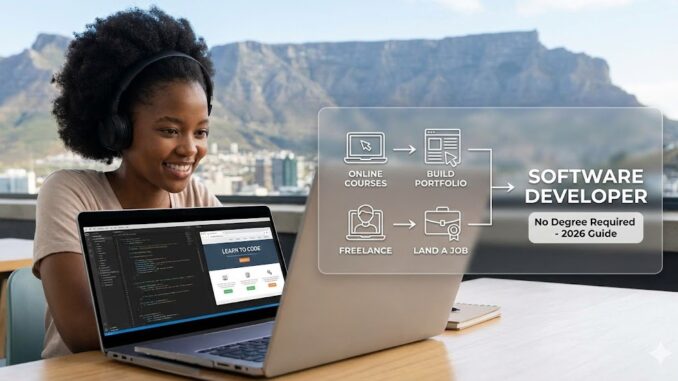
The dream of becoming a software developer is more achievable than ever before, and the best part? You don’t need a university degree to break into this lucrative field. In South Africa, software developers are earning between R300,000 and R900,000 per year, with senior developers and specialists commanding salaries well over R1,000,000 annually.
The tech industry is experiencing a massive skills shortage, with thousands of unfilled developer positions across the country. Companies are increasingly focused on skills and practical experience rather than formal qualifications. This shift has opened the door for self-taught developers, bootcamp graduates, and career changers to enter one of the most rewarding and future-proof careers available.
Whether you’re a recent matric graduate, someone looking to switch careers, or simply passionate about technology and problem-solving, this comprehensive guide will show you exactly how to become a software developer in South Africa without a traditional degree.
Why Software Development is an Excellent Career Choice in South Africa
Before diving into the how-to, let’s look at why software development is such an attractive career path:
High Earning Potential: Entry-level developers in South Africa earn R250,000 to R400,000 per year. With just two to three years of experience, you can easily earn R500,000 to R700,000. Senior developers and specialists often earn R800,000 to R1,500,000 or more.
Remote Work Opportunities: Software development is one of the most remote-friendly careers. Many South African developers work for international companies, earning salaries in dollars or euros while living in South Africa. This can dramatically increase your purchasing power.
Job Security: The demand for developers far exceeds the supply. The tech skills shortage means you’ll have job security and leverage when negotiating salaries and benefits.
Continuous Learning: Technology constantly evolves, which means your work stays interesting and challenging. You’ll never stop learning and growing in this field.
Global Opportunities: Programming skills are universal. A developer trained in South Africa can work anywhere in the world, either remotely or by relocating.
Creative Problem-Solving: Development combines logical thinking with creativity. You get to build products, solve real problems, and see the tangible results of your work.
The Reality Check: What You Need to Know
While becoming a developer without a degree is absolutely possible, it’s important to be realistic about what’s required:
Time Investment: Expect to dedicate 6 to 18 months of focused learning before you’re job-ready. This varies based on how much time you can commit daily and your starting knowledge level.
Self-Discipline Required: Without the structure of a university program, you’ll need strong self-motivation and discipline to stay on track with your learning.
Initial Salary Expectations: Your first developer job will likely pay R250,000 to R350,000 per year. This is still excellent compared to many other entry-level positions, and salaries increase rapidly with experience.
Continuous Learning: Technology changes quickly. You’ll need to commit to lifelong learning to stay relevant in the field.
Portfolio is Crucial: Without a degree, your portfolio of projects becomes your primary credential. You’ll need to invest time building impressive projects that demonstrate your skills.
Step 1: Choose Your Development Path
Software development isn’t a single career but rather a collection of specializations. Your first decision is choosing which type of development to pursue:
Front-End Development (Most Beginner-Friendly)
Front-end developers create the visual parts of websites and applications that users interact with. This path is often recommended for beginners because results are immediately visible and rewarding.
Core Technologies: HTML, CSS, JavaScript, React or Vue.js
Average Salary: R350,000 – R700,000 per year
Best For: People who enjoy design, user experience, and seeing immediate visual results of their code
Back-End Development
Back-end developers work on server-side logic, databases, and application architecture. This involves more abstract problem-solving and working with data.
Core Technologies: Node.js, Python, Java, or C#, databases (PostgreSQL, MongoDB)
Average Salary: R400,000 – R800,000 per year
Best For: People who enjoy logic puzzles, working with data, and building robust systems
Full-Stack Development (Recommended)
Full-stack developers can work on both front-end and back-end, making them highly versatile and valuable to employers. This is the most common path and offers the best job prospects.
Core Technologies: HTML, CSS, JavaScript, React, Node.js, databases
Average Salary: R450,000 – R900,000 per year
Best For: People who want maximum flexibility and the ability to build complete applications independently
Mobile Development
Mobile developers create applications for iOS and Android devices. This specialization is in high demand as businesses increasingly focus on mobile experiences.
Core Technologies: React Native, Flutter, or native development (Swift for iOS, Kotlin for Android)
Average Salary: R400,000 – R850,000 per year
Best For: People interested in app development and mobile user experiences
Recommendation for Beginners: Start with front-end development or the full-stack path. These offer the quickest route to employability and provide a foundation you can build upon.
Step 2: Create Your Learning Plan
Once you’ve chosen your path, you need a structured learning plan. Here’s a proven roadmap for becoming a full-stack developer:
Months 1-2: Web Development Fundamentals
Start with the absolute basics that every developer needs to know.
What to Learn:
- HTML5 (structure of web pages)
- CSS3 (styling and layout)
- Basic JavaScript (programming fundamentals)
- How the internet and web browsers work
- Version control with Git and GitHub
Time Commitment: 15-20 hours per week
Free Resources:
- freeCodeCamp (comprehensive and free)
- The Odin Project (project-based learning)
- MDN Web Docs (excellent reference)
- YouTube channels: Traversy Media, Web Dev Simplified
Paid Resources (Optional):
- Udemy courses (R200-R500 during sales)
- Scrimba Interactive courses
- Frontend Mentor (practice projects)
Goal by End of Month 2: Build a personal portfolio website and 2-3 simple projects (calculator, to-do list, landing page)
Months 3-4: JavaScript Deep Dive
JavaScript is the most important language for web development. This period focuses on becoming proficient.
What to Learn:
- JavaScript ES6+ features
- DOM manipulation
- Asynchronous programming (promises, async/await)
- APIs and working with data
- Basic algorithms and data structures
Projects to Build:
- Weather app using a public API
- Recipe finder application
- Quiz game with score tracking
- Budget tracker with local storage
Resources:
- JavaScript.info (comprehensive free guide)
- Eloquent JavaScript (free book)
- JavaScript30 by Wes Bos (free video course)
Goal: Comfortable solving coding challenges on platforms like Codewars or LeetCode (8 kyu to 6 kyu level)
Months 5-6: Front-End Framework (React)
Modern web development requires knowledge of a JavaScript framework. React is the most in-demand in South Africa.
What to Learn:
- React fundamentals (components, props, state)
- React Hooks
- State management (Context API, later Redux)
- Routing with React Router
- API integration in React
Projects to Build:
- Movie database app (using TMDB API)
- E-commerce product page
- Social media dashboard
- Task management application
Resources:
- Official React documentation
- React course on Scrimba or Udemy
- Full Stack Open (free, comprehensive)
Goal: Build at least 3 substantial React applications for your portfolio
Months 7-9: Back-End Development
Now add server-side skills to become a full-stack developer.
What to Learn:
- Node.js and Express.js
- RESTful API design
- Database fundamentals (SQL and NoSQL)
- Authentication and security
- Deployment basics
Projects to Build:
- Blog API with CRUD operations
- User authentication system
- Real-time chat application
- Full-stack e-commerce site
Resources:
- The Net Ninja (YouTube channel)
- Node.js documentation
- PostgreSQL or MongoDB tutorials
- Postman for API testing
Goal: Build a complete full-stack application with user authentication and database
Months 10-12: Advanced Topics and Job Preparation
The final stretch focuses on rounding out your skills and preparing for the job market.
What to Learn:
- Testing (Jest, React Testing Library)
- TypeScript (increasingly important)
- CI/CD basics
- Cloud platforms (AWS, Azure, or Google Cloud basics)
- Interview preparation (algorithms, system design)
Focus Areas:
- Refining your portfolio
- Contributing to open-source projects
- Building a complete, production-ready capstone project
- Practicing coding interviews
- Networking with other developers
Goal: Have a professional portfolio, GitHub profile, LinkedIn presence, and confidence to start applying for jobs
Step 3: Choose Your Learning Method
You have several options for how to structure your learning journey:
Self-Taught Route (Most Affordable)
Cost: R0 – R5,000 for optional paid resources
Duration: 12-18 months
Pros: Flexible schedule, lowest cost, learn at your own pace, strong self-discipline development
Cons: Requires high self-motivation, no structured guidance, longer time to job-ready, networking challenges
Best For: People with strong self-discipline, those who can’t afford bootcamps, individuals who prefer independent learning
Online Bootcamps (Balanced Approach)
Cost: R30,000 – R80,000
Duration: 3-9 months
Popular South African Options:
- HyperionDev (payment plans available, accredited)
- CodeSpace Academy (affordable, job placement support)
- WeThinkCode_ (free but highly competitive and intensive)
Pros: Structured curriculum, mentorship support, job placement assistance, faster time to employment
Cons: Significant financial investment, intense time commitment, fixed schedule
Best For: People who want structure and accountability, those who can commit full-time or substantial part-time hours
University Short Courses
Cost: R15,000 – R50,000
Duration: 6-12 months
Options:
- UCT Online (various coding courses)
- GetSmarter (university-backed programs)
- UNISA short courses
Pros: University credential, structured learning, some recognition from employers
Cons: More expensive than self-teaching, less intensive than bootcamps, may cover less practical content
Best For: People who value traditional credentials, those with flexible budgets
Hybrid Approach (Recommended)
Many successful developers combine methods, for example:
- Self-study using free resources for fundamentals
- Paid course or bootcamp for advanced topics and structure
- Active participation in coding communities for networking
Step 4: Build an Impressive Portfolio
Your portfolio is your most important asset when you don’t have a degree. Here’s how to make it stand out:
Quality Over Quantity
Rather than 20 basic projects, focus on 4-6 excellent ones that showcase different skills.
Must-Have Portfolio Projects:
- Personal Portfolio Website (shows front-end skills)
- Clean, professional design
- Responsive on all devices
- Fast loading times
- Clear presentation of your projects
- Full-Stack CRUD Application (shows full-stack ability)
- User authentication
- Database integration
- RESTful API
- Example: Task manager, blog platform, inventory system
- API Integration Project (shows you can work with external data)
- Consumes a public API
- Good error handling
- Appealing UI
- Example: Weather dashboard, recipe finder, stock tracker
- Complex Interactive Application (shows advanced JavaScript)
- Multiple features and components
- State management
- Good user experience
- Example: E-commerce site, social media clone, game
- Original Idea Project (shows creativity and initiative)
- Solves a real problem
- Your own concept
- Demonstrates passion
- Example: Community marketplace, local service finder
Portfolio Best Practices:
- Write clear README files for each project explaining what it does, technologies used, and how to run it
- Deploy all projects live (use Netlify, Vercel, or Heroku for free hosting)
- Include screenshots or demo videos
- Show clean, well-commented code
- Include links to live projects and GitHub repositories
- Add a brief case study for your best projects explaining your process
Step 5: Master the Fundamentals
While frameworks and tools change, core programming concepts remain essential. Make sure you understand:
Problem-Solving and Algorithms:
- Practice on Codewars, LeetCode, or HackerRank
- Start with easy problems and gradually increase difficulty
- Focus on understanding solutions, not just copying code
- Aim to solve at least 50-100 problems before job hunting
Data Structures:
- Arrays, objects, strings
- Linked lists, stacks, queues
- Trees and graphs (basic understanding)
- Hash tables
Core CS Concepts:
- Time and space complexity (Big O notation)
- How the internet works
- HTTP and REST principles
- Database design basics
- Security best practices
Clean Code Practices:
- Readable, maintainable code
- Proper naming conventions
- DRY principle (Don’t Repeat Yourself)
- Separation of concerns
- Testing your code
Step 6: Build Your Professional Presence
As you’re learning, start building your professional presence:
GitHub Profile:
- Commit code regularly (green squares show activity)
- Pin your best projects to your profile
- Write detailed README files
- Contribute to open-source projects if possible
- Use descriptive commit messages
LinkedIn Profile:
- Professional photo
- Headline: “Aspiring Full-Stack Developer” or “Junior Software Developer”
- Detailed skills section
- Share your learning journey and projects
- Connect with other developers and recruiters
- Engage with tech content
Twitter/X (Optional but Valuable):
- Follow developers and companies
- Share your learning progress (#100DaysOfCode)
- Engage with the tech community
- Build in public (share your projects and challenges)
Developer Communities:
- Join South African developer communities (ZATech, DevChat, Developer Circles)
- Attend meetups and tech events (in-person or virtual)
- Participate in hackathons
- Network with other developers
Step 7: Gain Practical Experience
Before landing your first job, find ways to get real-world experience:
Freelance Projects (Even Small Ones):
- Build websites for local businesses, churches, or NPOs
- Charge minimal fees or work pro bono for portfolio pieces
- Use Upwork or Fiverr to find small projects
- Each project adds credibility
Open Source Contributions:
- Find beginner-friendly projects on GitHub
- Start with documentation improvements
- Fix small bugs
- Shows collaboration skills and initiative
Build for Real Users:
- Create tools that solve actual problems
- Get feedback from real users
- Shows you can build practical applications
- Example: Create a tool for your current workplace
Internships or Junior Positions:
- Some companies offer internships for bootcamp graduates
- Consider taking a lower salary initially for experience
- Startup companies are often more open to self-taught developers
Step 8: Prepare for Job Applications
When you’re 70-80% ready, start applying. Don’t wait for perfection.
Resume Tips:
- Lead with projects and skills, not education
- Quantify achievements where possible
- Keep it to one page
- Use keywords from job descriptions
- Include links to portfolio and GitHub
Cover Letter Strategy:
- Address the specific role
- Explain your transition into development
- Highlight your passion and self-learning ability
- Mention specific technologies you’ve used
- Show you’ve researched the company
Where to Apply:
- OfferZen (specialized tech recruitment)
- LinkedIn Jobs
- Indeed South Africa
- AngelList (for startups)
- Company websites directly
- Your network
Application Strategy:
- Apply to 5-10 positions per week
- Focus on junior roles and companies hiring bootcamp grads
- Don’t be discouraged by rejections (they’re normal)
- Startups and smaller companies are often more receptive
- Consider remote-first companies
Step 9: Ace the Technical Interview
Developer interviews typically include several components:
Coding Challenges:
- Practice on LeetCode, HackerRank, Codewars
- Focus on easy to medium problems
- Practice explaining your thinking out loud
- Time yourself to build pressure tolerance
- Review solutions after completing problems
Technical Discussions:
- Be prepared to explain your projects in detail
- Discuss trade-offs in your technical decisions
- Show enthusiasm for learning
- Be honest about what you don’t know
Behavioral Questions:
- Prepare stories about overcoming challenges
- Discuss how you learned to code
- Talk about collaborative projects
- Show soft skills and cultural fit
Live Coding:
- Practice coding while speaking
- Clarify requirements before starting
- Think out loud
- Test your code
- Don’t panic if stuck (ask for hints)
Interview Preparation Resources:
- Cracking the Coding Interview (book)
- Pramp (free mock interviews)
- InterviewCake
- System Design Primer (GitHub)
Common Challenges and How to Overcome Them
“I’m not smart enough for programming”
Programming is a skill, not a talent. Everyone struggles initially. The difference between successful and unsuccessful learners is persistence, not intelligence.
“I’m too old to start”
Many successful developers changed careers in their 30s, 40s, or even 50s. Your previous experience brings valuable perspective. Companies value maturity and diverse backgrounds.
“The technology keeps changing”
Focus on fundamentals first. Once you understand core concepts, learning new frameworks becomes much easier. Change is constant in tech, which keeps it interesting.
“I keep getting stuck and frustrated”
This is normal and happens to everyone. When stuck, take breaks, search for solutions, ask for help in communities, and remember that struggle is part of learning.
“I don’t have time with my full-time job”
Many developers learned while working full-time. Dedicate 1-2 hours daily, wake up earlier, or use weekends. Consistency matters more than the number of hours per day.
“I can’t afford expensive bootcamps”
Everything you need to learn is available free online. Bootcamps accelerate the process but aren’t necessary. Self-taught developers get hired every day.
Estimated Costs Breakdown
Here’s what you can expect to spend:
Minimum Budget (Self-Taught):
- Computer (if needed): R5,000 – R15,000
- Internet: R500 – R1,000 per month
- Free online resources: R0
- Total: R5,000 – R27,000 over 12 months
Mid-Range Budget:
- Computer: R8,000 – R20,000
- Internet: R500 – R1,000 per month
- Paid courses: R2,000 – R8,000
- Books and resources: R500 – R2,000
- Total: R17,000 – R50,000
Premium Budget (Bootcamp):
- Computer: R10,000 – R25,000
- Internet: R500 – R1,000 per month
- Bootcamp: R30,000 – R80,000
- Additional resources: R2,000 – R5,000
- Total: R48,000 – R122,000
ROI: Even with the premium budget, you’ll likely recover your investment within 3-6 months of employment at entry-level developer salaries.
Timeline to Employment
Here are realistic timelines based on different approaches:
Full-Time Learning (40+ hours/week):
- Self-taught: 6-9 months to job-ready
- Bootcamp: 3-6 months to job-ready
Part-Time Learning (10-20 hours/week):
- Self-taught: 12-18 months to job-ready
- Online bootcamp: 9-12 months to job-ready
Casual Learning (5-10 hours/week):
- Self-taught: 18-24 months to job-ready
Remember, “job-ready” means you can get your first position. You’ll continue learning on the job.
Your Next Steps: Getting Started Today
Ready to begin your journey to becoming a software developer? Here’s what to do right now:
Today:
- Choose your learning path (front-end, back-end, or full-stack)
- Create accounts on freeCodeCamp and GitHub
- Write down your “why” – your motivation for becoming a developer
- Complete your first HTML lesson
This Week:
- Set up your development environment (VS Code, Git)
- Complete the first section of your chosen course
- Build your first simple webpage
- Join a South African developer community online
This Month:
- Establish a daily coding habit (even 30 minutes counts)
- Complete HTML and CSS fundamentals
- Start learning JavaScript basics
- Begin planning your first project
The First 90 Days:
- Complete web development fundamentals
- Build 3-5 simple projects
- Start your portfolio website
- Network with other beginner developers
Final Thoughts
Becoming a software developer without a degree is challenging but absolutely achievable. Thousands of South Africans have successfully made this transition, and you can too.
The key ingredients for success are:
- Consistent daily practice
- Building real projects, not just following tutorials
- Staying patient through the frustration
- Engaging with the developer community
- Never stopping learning
The journey from complete beginner to employed developer typically takes 6-18 months of focused effort. Yes, it’s hard work. Yes, there will be moments of doubt. But the career opportunities, earning potential, and personal growth make it incredibly worthwhile.
Start today. Write your first line of code. Join your first online community. Take the first step toward a career that offers financial security, creative fulfillment, and unlimited growth potential.
Your future as a software developer starts now.
Ready to begin? Drop a comment below about which learning path you’re choosing, or ask any questions about getting started!
Leave a Reply